|
simstr 1.3.1
Yet another strings library
|

|
|
simstr 1.3.1
Yet another strings library
|
|
A class with basic constant string algorithms. More...
#include <sstring.h>
Public Member Functions | |
| constexpr K * | place (K *ptr) const noexcept |
| Copy the string to the specified buffer. | |
| void | copy_to (K *buffer, size_t bufSize) |
| Copy the string to the specified buffer. | |
| constexpr size_t | size () const |
| The size of the string in characters. | |
| constexpr | operator str_piece () const noexcept |
| Convert itself to a "string chunk" that includes the entire string. | |
| constexpr str_piece | to_str () const noexcept |
| Convert itself to a "string chunk" that includes the entire string. | |
| template<typename = int> requires is_one_of_std_char_v<K> | |
| constexpr std::basic_string_view< K > | to_sv () const noexcept |
| Convert to std::string_view. | |
| template<typename = int> requires is_one_of_std_char_v<K> | |
| constexpr std::basic_string< K > | to_string () const noexcept |
| Convert to std::string. | |
| constexpr str_piece | operator() (ptrdiff_t from, ptrdiff_t len=0) const noexcept |
| Get part of a string as "simple_str". | |
| constexpr str_piece | mid (size_t from, size_t len=-1) const noexcept |
| Get part of a string as "string chunk". | |
| constexpr str_piece | from_to (size_t from, size_t to) const noexcept |
| Get the substring simple_str from position from to position to (not including it). | |
| constexpr bool | operator! () const noexcept |
| Check for emptiness. | |
| constexpr K | at (ptrdiff_t idx) const |
| Get the character at the given position. | |
| constexpr int | compare (str_piece o) const |
| Compare strings character by character. | |
| constexpr int | strcmp (const K *text) const |
| Compare with C-string character by character. | |
| constexpr bool | equal (str_piece other) const noexcept |
| String comparison for equality. | |
| constexpr bool | operator== (const base &other) const noexcept |
| Operator comparing strings for equality. | |
| constexpr auto | operator<=> (const base &other) const noexcept |
| String comparison operator. | |
| template<typename T, size_t N = const_lit_for<K, T>::Count> | |
| constexpr bool | operator== (T &&other) const noexcept |
| Operator for comparing a string and a string literal for equality. | |
| template<typename T, size_t N = const_lit_for<K, T>::Count> | |
| constexpr auto | operator<=> (T &&other) const noexcept |
| Comparison operator between a string and a string literal. | |
| constexpr int | compare_ia (str_piece text) const noexcept |
| Compare strings character by character and not case sensitive ASCII characters. | |
| constexpr bool | equal_ia (str_piece text) const noexcept |
| Whether a string is equal to another string, character-by-character-insensitive, of ASCII characters. | |
| constexpr bool | less_ia (str_piece text) const noexcept |
| Whether a string is smaller than another string, character-by-character-insensitive, ASCII characters. | |
| int | compare_iu (str_piece text) const noexcept |
| Compare strings character by character without taking into account the case of Unicode characters of the first plane (<0xFFFF). | |
| bool | equal_iu (str_piece text) const noexcept |
| Whether a string is equal to another string, character-by-character-insensitive, of the Unicode characters of the first plane (<0xFFFF). | |
| bool | less_iu (str_piece text) const noexcept |
| Whether a string is smaller than another string, character-by-character-insensitive, of the Unicode characters of the first plane (<0xFFFF). | |
| constexpr size_t | find (str_piece pattern, size_t offset=0) const noexcept |
| Find the beginning of the first occurrence of a substring in this string. | |
| template<typename Exc, typename ... Args> requires std::is_constructible_v<Exc, Args...> | |
| constexpr size_t | find_or_throw (str_piece pattern, size_t offset=0, Args &&... args) const noexcept |
| Find the beginning of the first occurrence of a substring in this string or throw an exception. | |
| constexpr size_t | find_end (str_piece pattern, size_t offset=0) const noexcept |
| Find the end of the occurrence of a substring in this string. | |
| constexpr size_t | find_or_all (str_piece pattern, size_t offset=0) const noexcept |
| Find the beginning of the first occurrence of a substring in this string or the end of the string. | |
| constexpr size_t | find_end_or_all (str_piece pattern, size_t offset=0) const noexcept |
| Find the end of the first occurrence of a substring in this string, or the end of a string. | |
| constexpr size_t | find_last (str_piece pattern, size_t offset=-1) const noexcept |
| Find the beginning of the last occurrence of a substring in this string. | |
| constexpr size_t | find_end_of_last (str_piece pattern, size_t offset=-1) const noexcept |
| Find the end of the last occurrence of a substring in this string. | |
| constexpr size_t | find_last_or_all (str_piece pattern, size_t offset=-1) const noexcept |
| Find the beginning of the last occurrence of a substring in this string or the end of the string. | |
| constexpr size_t | find_end_of_last_or_all (str_piece pattern, size_t offset=-1) const noexcept |
| Find the end of the last occurrence of a substring in this string, or the end of a string. | |
| constexpr bool | contains (str_piece pattern, size_t offset=0) const noexcept |
| Whether the string contains the specified substring. | |
| constexpr size_t | find (K s, size_t offset=0) const noexcept |
| Find a character in this string. | |
| constexpr size_t | find_or_all (K s, size_t offset=0) const noexcept |
| Find a character in this string or the end of a string. | |
| template<typename Op> | |
| constexpr void | for_all_finded (const Op &op, str_piece pattern, size_t offset=0, size_t maxCount=0) const |
| Call a functor on all found occurrences of a substring in this string. | |
| constexpr std::vector< size_t > | find_all (str_piece pattern, size_t offset=0, size_t maxCount=0) const |
| Find all occurrences of a substring in this string. | |
| constexpr size_t | find_last (K s, size_t offset=-1) const noexcept |
| Find the last occurrence of a character in this string. | |
| constexpr size_t | find_first_of (str_piece pattern, size_t offset=0) const noexcept |
| Find the first occurrence of a character from a given character set. | |
| constexpr std::pair< size_t, size_t > | find_first_of_idx (str_piece pattern, size_t offset=0) const noexcept |
| Find the first occurrence of a character from a given character set. | |
| constexpr size_t | find_first_not_of (str_piece pattern, size_t offset=0) const noexcept |
| Find the first occurrence of a character not from the given character set. | |
| constexpr size_t | find_last_of (str_piece pattern, size_t offset=str::npos) const noexcept |
| Find the last occurrence of a character from a given character set. | |
| constexpr std::pair< size_t, size_t > | find_last_of_idx (str_piece pattern, size_t offset=str::npos) const noexcept |
| Find the last occurrence of a character from a given character set. | |
| constexpr size_t | find_last_not_of (str_piece pattern, size_t offset=str::npos) const noexcept |
| Find the last occurrence of a character not from the given character set. | |
| constexpr my_type | substr (ptrdiff_t from, ptrdiff_t len=0) const |
| Get a substring. Works similarly to operator(), only the result is the same type as the method applied to. | |
| constexpr my_type | str_mid (size_t from, size_t len=-1) const |
| Get part of a string with an object of the same type to which the method is applied, similar to mid. | |
| template<ToIntNumber T, bool CheckOverflow = true, unsigned Base = 0, bool SkipWs = true, bool AllowSign = true> | |
| constexpr T | as_int () const noexcept |
| Convert a string to a number of the given type. | |
| template<ToIntNumber T, bool CheckOverflow = true, unsigned Base = 0, bool SkipWs = true, bool AllowSign = true> | |
| constexpr convert_result< T > | to_int () const noexcept |
| Convert a string to a number of the given type. | |
| template<bool SkipWS = true, bool AllowPlus = true> | |
| std::optional< double > | to_double () const noexcept |
| Convert string to double. | |
| template<bool SkipWS = true> requires (sizeof(K) == 1) | |
| std::optional< double > | to_double_hex () const noexcept |
| Convert string in hex form to double. | |
| template<ToIntNumber T> | |
| constexpr void | as_number (T &t) const |
| Convert a string to an integer. | |
| void | as_number (double &t) const |
| Convert string to double. | |
| template<typename T, typename Op> | |
| constexpr T | splitf (str_piece delimeter, const Op &beforeFunc, size_t offset=0) const |
| Split a string into parts at a given delimiter, possibly applying a functor to each substring. | |
| template<typename T> | |
| constexpr T | split (str_piece delimeter, size_t offset=0) const |
| Split a string into substrings using a given delimiter. | |
| constexpr Splitter< K > | splitter (str_piece delimeter) const |
Retrieve a Splitter object by the given splitter, which allows sequential get substrings using the next() method while is_done() is false. | |
| constexpr bool | starts_with (str_piece prefix) const noexcept |
| Whether the string begins with the given substring. | |
| constexpr bool | starts_with_ia (str_piece prefix) const noexcept |
| Whether the string begins with the given substring in a case-insensitive ASCII character. | |
| bool | starts_with_iu (str_piece prefix) const noexcept |
| Whether the string starts with the given substring, case-insensitive Unicode characters of the first plane (<0xFFFF). | |
| constexpr bool | prefix_in (str_piece text) const noexcept |
| Whether this string is the beginning of another string. | |
| constexpr bool | ends_with (str_piece suffix) const noexcept |
| Whether the string ends with the specified substring. | |
| constexpr bool | ends_with_ia (str_piece suffix) const noexcept |
| Whether the string ends with the specified substring in a case-insensitive ASCII character. | |
| constexpr bool | ends_with_iu (str_piece suffix) const noexcept |
| Whether the string ends with the specified substring, case-insensitive Unicode characters of the first plane (<0xFFFF). | |
| constexpr bool | is_ascii () const noexcept |
| Whether the string contains only ASCII characters. | |
| template<typename R = my_type> | |
| R | upperred_only_ascii () const |
| Get a copy of the string in uppercase ASCII characters. | |
| template<typename R = my_type> | |
| R | lowered_only_ascii () const |
| Get a copy of the string in lowercase ASCII characters. | |
| template<typename R = my_type> | |
| R | upperred () const |
| Get a copy of the string in upper case Unicode characters of the first plane (<0xFFFF). | |
| template<typename R = my_type> | |
| R | lowered () const |
| Get a copy of the string in lowercase Unicode characters of the first plane (<0xFFFF). | |
| template<typename R = my_type> | |
| R | replaced (str_piece pattern, str_piece repl, size_t offset=0, size_t maxCount=0) const |
| Get a copy of the string with occurrences of substrings replaced. | |
| template<typename T, size_t N = const_lit_for<K, T>::Count, typename M, size_t L = const_lit_for<K, M>::Count> | |
| constexpr expr_replaces< K, N - 1, L - 1 > | replace_init (T &&pattern, M &&repl) const |
| Get a string expression that produces a string with replaced substrings given by string literals. | |
| template<typename R = str_piece> | |
| constexpr R | trimmed () const |
| Get a string with whitespace removed on the left and right. | |
| template<typename R = str_piece> | |
| R | trimmed_left () const |
| Get a string with whitespace removed on the left. | |
| template<typename R = str_piece> | |
| R | trimmed_right () const |
| Get a string with whitespace removed on the right. | |
| template<typename R = str_piece, typename T, size_t N = const_lit_for<K, T>::Count> requires is_const_pattern<N> | |
| R | trimmed (T &&pattern) const |
| Get a string with the characters specified by the string literal removed from the left and right. | |
| template<typename R = str_piece, typename T, size_t N = const_lit_for<K, T>::Count> requires is_const_pattern<N> | |
| R | trimmed_left (T &&pattern) const |
| Get a string with the characters specified by the string literal removed from the left. | |
| template<typename R = str_piece, typename T, size_t N = const_lit_for<K, T>::Count> requires is_const_pattern<N> | |
| R | trimmed_right (T &&pattern) const |
| Get a string with the characters specified by the string literal removed from the right. | |
| template<typename R = str_piece, typename T, size_t N = const_lit_for<K, T>::Count> requires is_const_pattern<N> | |
| R | trimmed_with_spaces (T &&pattern) const |
| Get a string with the characters specified by the string literal removed, as well as whitespace characters, left and right. | |
| template<typename R = str_piece, typename T, size_t N = const_lit_for<K, T>::Count> requires is_const_pattern<N> | |
| R | trimmed_left_with_spaces (T &&pattern) const |
| Get a string with the characters specified by the string literal removed, as well as whitespace characters, left. | |
| template<typename R = str_piece, typename T, size_t N = const_lit_for<K, T>::Count> requires is_const_pattern<N> | |
| R | trimmed_right_with_spaces (T &&pattern) const |
| Get a string with the characters specified by the string literal removed, as well as whitespace characters, right. | |
| template<typename R = str_piece> | |
| R | trimmed (str_piece pattern) const |
| Get a string with characters specified by another string removed, left and right. | |
| template<typename R = str_piece> | |
| R | trimmed_left (str_piece pattern) const |
| Get a string with characters specified by another string removed from the left. | |
| template<typename R = str_piece> | |
| R | trimmed_right (str_piece pattern) const |
| Get a string with characters specified by another string removed to the right. | |
| template<typename R = str_piece> | |
| R | trimmed_with_spaces (str_piece pattern) const |
| Get a string, removing characters specified by another string, as well as whitespace characters, left and right. | |
| template<typename R = str_piece> | |
| R | trimmed_left_with_spaces (str_piece pattern) const |
| Get a string, removing characters specified by another string, as well as whitespace characters, left. | |
| template<typename R = str_piece> | |
| R | trimmed_right_with_spaces (str_piece pattern) const |
| Get a string, removing characters specified by another string, as well as whitespace characters, right. | |
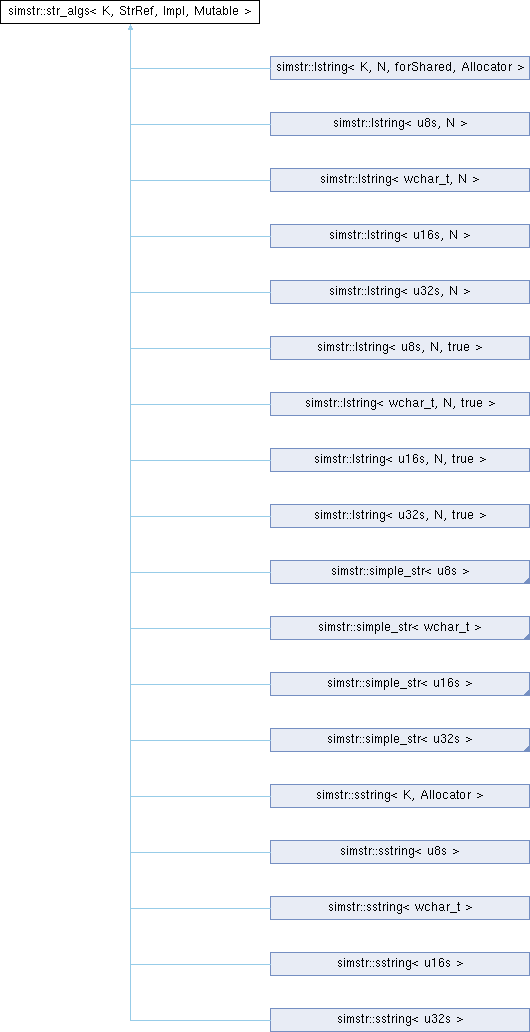
A class with basic constant string algorithms.
Is the base for classes that can perform constant operations on strings. Doesn’t know anything about storing strings, neither itself nor the descendant class, that is, it works only with a pointer to a string and its length. To work, the descendant class must implement the following methods:
| K | - character type. |
| StrRef | - storage type for the string chunk. |
| Impl | - the final class is the successor. |
|
inlineconstexprnoexcept |
Convert a string to a number of the given type.
| T | - the desired number type. |
| CheckOverflow | - check for overflow. |
| Base | - the base of the number, from -1 to 36, except 1.
|
| SkipWs | - skip whitespace characters at the beginning of the line. |
| AllowSign | - whether the '+' sign is allowed before a number. |
|
inline |
Convert string to double.
| t | - the variable into which the result is written. |
|
inlineconstexpr |
Convert a string to an integer.
| T | - number type, inferred from the argument. |
| t | - the variable into which the result is written. |
|
inlineconstexpr |
Get the character at the given position.
| idx | - symbol index. For negative values, it is counted from the end of the line. |
Does not check for line boundaries.
|
inlineconstexpr |
Compare strings character by character.
| o | - another line. |
|
inlineconstexprnoexcept |
Compare strings character by character and not case sensitive ASCII characters.
| text | - another line. |
|
inlinenoexcept |
Compare strings character by character without taking into account the case of Unicode characters of the first plane (<0xFFFF).
| text | - another line. |
|
inlineconstexprnoexcept |
Whether the string contains the specified substring.
| pattern | - the search string. |
| offset | - from which position to start the search. |
|
inline |
Copy the string to the specified buffer.
The method adds \0 after the copied characters. Does not exceed buffer boundaries.
| buffer | - pointer to buffer |
| bufSize | - buffer size in characters. |
|
inlineconstexprnoexcept |
Whether the string ends with the specified substring.
| suffix | - substring. |
|
inlineconstexprnoexcept |
Whether the string ends with the specified substring in a case-insensitive ASCII character.
| suffix | - substring. |
|
inlineconstexprnoexcept |
Whether the string ends with the specified substring, case-insensitive Unicode characters of the first plane (<0xFFFF).
| suffix | - substring. |
|
inlineconstexprnoexcept |
String comparison for equality.
| other | - another line. |
|
inlineconstexprnoexcept |
Whether a string is equal to another string, character-by-character-insensitive, of ASCII characters.
| text | - another line. |
|
inlinenoexcept |
Whether a string is equal to another string, character-by-character-insensitive, of the Unicode characters of the first plane (<0xFFFF).
| text | - another line. |
|
inlineconstexprnoexcept |
Find a character in this string.
| s | is an optional character. |
| offset | - from which position to start the search. |
|
inlineconstexprnoexcept |
Find the beginning of the first occurrence of a substring in this string.
| pattern | - the search string. |
| offset | - from which position to start the search. |
|
inlineconstexpr |
Find all occurrences of a substring in this string.
| pattern | - the substring to search for. |
| offset | - search start position. |
| maxCount | - the maximum number of occurrences to be processed, 0 - no restrictions. |
|
inlineconstexprnoexcept |
Find the end of the occurrence of a substring in this string.
| pattern | - the search string. |
| offset | - from which position to start the search. |
|
inlineconstexprnoexcept |
Find the end of the last occurrence of a substring in this string.
| pattern | - the search string. |
| offset | - from which position to search in the opposite direction, -1 - from the very end. |
|
inlineconstexprnoexcept |
Find the end of the last occurrence of a substring in this string, or the end of a string.
| pattern | - the search string. |
| offset | - from which position to search in the opposite direction, -1 - from the very end. |
|
inlineconstexprnoexcept |
Find the end of the first occurrence of a substring in this string, or the end of a string.
| pattern | - the search string. |
| offset | - from which position to start the search. |
|
inlineconstexprnoexcept |
Find the first occurrence of a character not from the given character set.
| pattern | - a string specifying the character set. |
| offset | - search start position. |
|
inlineconstexprnoexcept |
Find the first occurrence of a character from a given character set.
| pattern | - a string specifying the set of characters to search for. |
| offset | - search start position. |
|
inlineconstexprnoexcept |
Find the first occurrence of a character from a given character set.
| pattern | - a string specifying the set of characters to search for. |
| offset | - search start position. |
|
inlineconstexprnoexcept |
Find the last occurrence of a character in this string.
| s | is an optional character. |
| offset | - from which position to search in the opposite direction, -1 - from the very end. |
|
inlineconstexprnoexcept |
Find the beginning of the last occurrence of a substring in this string.
| pattern | - the search string. |
| offset | - from which position to search in the opposite direction, -1 - from the very end. |
|
inlineconstexprnoexcept |
Find the last occurrence of a character not from the given character set.
| pattern | - a string specifying the character set. |
| offset | - search start position. |
|
inlineconstexprnoexcept |
Find the last occurrence of a character from a given character set.
| pattern | - a string specifying the set of characters to search for. |
| offset | - search start position. |
|
inlineconstexprnoexcept |
Find the last occurrence of a character from a given character set.
| pattern | - a string specifying the set of characters to search for. |
| offset | - search start position. |
|
inlineconstexprnoexcept |
Find the beginning of the last occurrence of a substring in this string or the end of the string.
| pattern | - the search string. |
| offset | - from which position to search in the opposite direction, -1 - from the very end. |
|
inlineconstexprnoexcept |
Find a character in this string or the end of a string.
| s | is an optional character. |
| offset | - from which position to start the search. |
|
inlineconstexprnoexcept |
Find the beginning of the first occurrence of a substring in this string or the end of the string.
| pattern | - the search string. |
| offset | - from which position to start the search. |
|
inlineconstexprnoexcept |
Find the beginning of the first occurrence of a substring in this string or throw an exception.
| Exc | - exception type. |
| Args... | - types of parameters for constructing an exception, inferred from the arguments. |
| pattern | - the search string. |
| offset | - from which position to start the search. |
| args | - arguments for the exception constructor. |
|
inlineconstexpr |
Call a functor on all found occurrences of a substring in this string.
| op | is a functor that takes a string. |
| pattern | - the substring to search for. |
| offset | - search start position. |
| maxCount | - the maximum number of occurrences to be processed, 0 - no restrictions. |
|
inlineconstexprnoexcept |
Get the substring simple_str from position from to position to (not including it).
For performance reasons, the method does not check for line boundaries in any way, use in scenarios when you know for sure that these are positions inside the line and to >= from.
| from | - starting position. |
| to | - final position (not included in the result). |
|
inlineconstexprnoexcept |
Whether a string is smaller than another string, character-by-character-insensitive, ASCII characters.
| text | - another line. |
|
inlinenoexcept |
Whether a string is smaller than another string, character-by-character-insensitive, of the Unicode characters of the first plane (<0xFFFF).
| text | - another line. |
|
inline |
Get a copy of the string in lowercase Unicode characters of the first plane (<0xFFFF).
| R | - the desired string type, by default the same whose method was called. |
|
inline |
Get a copy of the string in lowercase ASCII characters.
| R | - the desired string type, by default the same whose method was called. |
|
inlineconstexprnoexcept |
Get part of a string as "string chunk".
| from | - number of characters from the beginning of the line. If the string size is exceeded, it will return an empty string. |
| len | - the number of characters in the resulting "chunk". When going beyond the line, it will return everything up to the end of the line. |
|
inlineconstexprnoexcept |
Convert itself to a "string chunk" that includes the entire string.
|
inlineconstexprnoexcept |
Get part of a string as "simple_str".
| from | - number of characters from the beginning of the line. |
| len | - the number of characters in the resulting "chunk". |
If from is less than zero, then -from characters are counted from the end of the line towards the beginning. If len is less than or equal to zero, then count -len characters from the end of the line
|
inlineconstexprnoexcept |
String comparison operator.
| other | - another line. |
|
inlineconstexprnoexcept |
Comparison operator between a string and a string literal.
| other | is a string literal. |
|
inlineconstexprnoexcept |
Operator comparing strings for equality.
| other | - another line. |
|
inlineconstexprnoexcept |
Operator for comparing a string and a string literal for equality.
| other | - string literal. |
|
inlineconstexprnoexcept |
Copy the string to the specified buffer.
The method assumes that the size of the allocated buffer is sufficient for the entire line, i.e. length() was previously requested. Does not add \0.
| ptr | - pointer to the buffer. |
|
inlineconstexprnoexcept |
Whether this string is the beginning of another string.
| text | - another string. |
|
inlineconstexpr |
Get a string expression that produces a string with replaced substrings given by string literals.
| pattern | - string literal, substring to be changed. |
| repl | - string literal, substring to change to. |
|
inline |
Get a copy of the string with occurrences of substrings replaced.
| R | - the desired string type, by default the same whose method was called. |
| pattern | - the substring to search for. |
| repl | - the string to replace with. |
| offset | - starting position of the search. |
| maxCount | - maximum number of replacements, 0 - no restrictions. |
|
inlineconstexpr |
The size of the string in characters.
|
inlineconstexpr |
Split a string into substrings using a given delimiter.
| T | - container type for the result. |
| delimeter | - delimiter. |
| offset | - the position to start searching for the separator. |
|
inlineconstexpr |
Split a string into parts at a given delimiter, possibly applying a functor to each substring.
| T | - type of container for folding substrings. |
| delimeter | - substring delimiter. |
| beforeFunc | - a functor to apply to the found substrings, before placing them in the result. |
| offset | - the position to start searching for the separator. |
For each substring found, if the functor can accept it, the functor is called, and the substring is assigned to the result of the functor. Next, the substring tries to be added to the result, calling one of its methods - emplace_back, push_back, operator[]. If none of this method no, nothing is done, just calling the functor. operator[] tries to apply if the result can have a size via std::size and we do not exceed this size. At the same time, if the found substring turns out to match the entire string, the result is attempted place not a substring, but the entire string object, which allows, for example, to effectively copy sstring.
|
constexpr |
Retrieve a Splitter object by the given splitter, which allows sequential get substrings using the next() method while is_done() is false.
| delimeter | - delimiter. |
|
inlineconstexprnoexcept |
Whether the string begins with the given substring.
| prefix | - substring. |
|
inlineconstexprnoexcept |
Whether the string begins with the given substring in a case-insensitive ASCII character.
| prefix | - substring. |
|
inlinenoexcept |
Whether the string starts with the given substring, case-insensitive Unicode characters of the first plane (<0xFFFF).
| prefix | - substring. |
|
inlineconstexpr |
Get part of a string with an object of the same type to which the method is applied, similar to mid.
| from | - number of characters from the beginning of the line. If the string size is exceeded, it will return an empty string. |
| len | - the number of characters in the resulting "chunk". When going beyond the line, it will return everything up to the end of the line. |
|
inlineconstexpr |
Compare with C-string character by character.
| text | - another line. |
|
inlineconstexpr |
Get a substring. Works similarly to operator(), only the result is the same type as the method applied to.
| from | - number of characters from the beginning of the line. If less than zero, it is counted from the end of the line towards the beginning. |
| len | - the number of characters in the resulting "chunk". If less than or equal to zero, then count len characters from the end of the line. |
|
inlinenoexcept |
Convert string to double.
|
inlinenoexcept |
Convert string in hex form to double.
|
inlineconstexprnoexcept |
Convert a string to a number of the given type.
| T | - the desired number type. |
| CheckOverflow | - check for overflow. |
| Base | - the base of the number, from -1 to 36, except 1.
|
| SkipWs | - skip whitespace characters at the beginning of the line. All characters with ASCII codes <= 32 are skipped. |
| AllowSign | - whether the '+' sign is allowed before a number. |
|
inlineconstexprnoexcept |
Convert itself to a "string chunk" that includes the entire string.
|
inlineconstexprnoexcept |
Convert to std::string.
|
inlineconstexprnoexcept |
Convert to std::string_view.
|
inlineconstexpr |
Get a string with whitespace removed on the left and right.
| R | - desired string type, default simple_str. |
|
inline |
Get a string with characters specified by another string removed, left and right.
| R | - desired string type, default simple_str. |
| pattern | - a string specifying the characters that will be trimmed. |
|
inline |
Get a string with the characters specified by the string literal removed from the left and right.
| R | - desired string type, default simple_str. |
| pattern | is a string literal specifying the characters that will be trimmed. |
|
inline |
Get a string with whitespace removed on the left.
| R | - desired string type, default simple_str. |
|
inline |
Get a string with characters specified by another string removed from the left.
| R | - desired string type, default simple_str. |
| pattern | - a string specifying the characters that will be trimmed. |
|
inline |
Get a string with the characters specified by the string literal removed from the left.
| R | - desired string type, default simple_str. |
| pattern | is a string literal specifying the characters that will be trimmed. |
|
inline |
Get a string, removing characters specified by another string, as well as whitespace characters, left.
| R | - desired string type, default simple_str. |
| pattern | - a string specifying the characters that will be trimmed. |
|
inline |
Get a string with the characters specified by the string literal removed, as well as whitespace characters, left.
| R | - desired string type, default simple_str. |
| pattern | is a string literal specifying the characters that will be trimmed. |
|
inline |
Get a string with whitespace removed on the right.
| R | - desired string type, default simple_str. |
|
inline |
Get a string with characters specified by another string removed to the right.
| R | - desired string type, default simple_str. |
| pattern | - a string specifying the characters that will be trimmed. |
|
inline |
Get a string with the characters specified by the string literal removed from the right.
| R | - desired string type, default simple_str. |
| pattern | is a string literal specifying the characters that will be trimmed. |
|
inline |
Get a string, removing characters specified by another string, as well as whitespace characters, right.
| R | - desired string type, default simple_str. |
| pattern | - a string specifying the characters that will be trimmed. |
|
inline |
Get a string with the characters specified by the string literal removed, as well as whitespace characters, right.
| R | - desired string type, default simple_str. |
| pattern | is a string literal specifying the characters that will be trimmed. |
|
inline |
Get a string, removing characters specified by another string, as well as whitespace characters, left and right.
| R | - desired string type, default simple_str. |
| pattern | - a string specifying the characters that will be trimmed. |
|
inline |
Get a string with the characters specified by the string literal removed, as well as whitespace characters, left and right.
| R | - desired string type, default simple_str. |
| pattern | is a string literal specifying the characters that will be trimmed. |
|
inline |
Get a copy of the string in upper case Unicode characters of the first plane (<0xFFFF).
| R | - the desired string type, by default the same whose method was called. |
|
inline |
Get a copy of the string in uppercase ASCII characters.
| R | - the desired string type, by default the same whose method was called. |
 1.13.2